Fractional laser is generally suitable for the treatment of problems such as scars and acne marks; Q-switched laser is mainly used for pigmented skin diseases, and picosecond laser is mainly used to remove black, blue, green tattoos and stubborn pigments.
Case Details
What is the difference between fractional laser, Q-switched laser and picosecond laser?
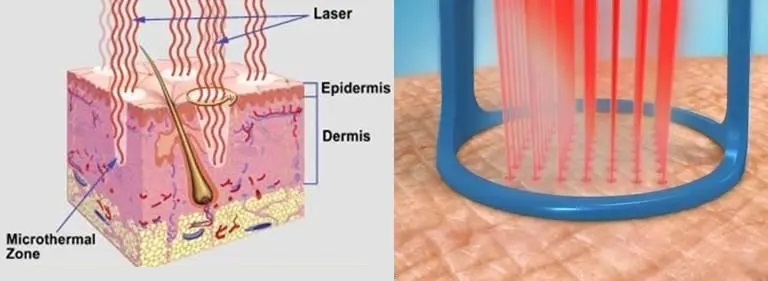 Fractal laserIt can be mainly divided into: ruby fractional laser, erbium laser fractional laser, co2 fractional laser, 1550nm fractional laser, 2940nm erbium glass fractional laser, 10600nm ultra-pulsed carbon dioxide fractional laser.Fractal laser is not a laser, but a working mode of the laser. As long as the diameter of the laser beam (spot) is less than 500 μm and the laser beam is regularly arranged in a dotted shape, the laser working mode at this time is fractional laser.It is divided into two types: ablative and non-ablative. It plays a therapeutic role through the focal photothermal effect of the laser. It is generally suitable for the treatment of problems such as scars and acne pits.Q-switched laser:Q-switching is a technology for obtaining a specific type of laser, and common names also include Q switch. Q-switched laser can choose a variety of modes and wavelengths for more targeted treatment.The pulse width of traditional Q-switched laser is at the nanosecond level. Commonly used ones include Q1064, Q755, Q694, and Q532. The following numbers are the wavelengths of this Q-switched laser. The smaller the wavelength, the higher the melanin absorption rate and the shallower the penetration ability.Mainly for pigmented skin diseases, it can treat various pigmented lesions from the epidermis to the dermis (such as freckles, age spots, freckle-like nevus, coffee spots, Ota nevus, brown-blue nevus, etc.) and remove cold and warm (such as red, light blue, green, blue, black, etc.) tattoos.PicosecondWhether it is traditional Q-switched laser or picosecond, ultra-picosecond, they all belong to Q-switched laser. "Picosecond" is a unit of time. "Picosecond laser" means that the pulse width of the laser reaches the picosecond level, which is only 1/1000 of the nanosecond level of traditional Q-switched laser. Picosecond laser is not so mysterious, it just shortens the pulse width of the laser. The shorter the pulse width, the less the light energy will diverge to the surrounding tissues, the more the energy will be concentrated at the target tissue, and the stronger the effect on the target tissue. Picosecond laser is mainly used to remove black, blue, green tattoos and stubborn pigments.
Fractional laser is generally suitable for the treatment of problems such as scars and acne marks; Q-switched laser is mainly used for pigmented skin diseases, and picosecond laser is mainly used to remove black, blue, green tattoos and stubborn pigments.


